OTS Member Highlight – Keith T. Gagnon, PhD
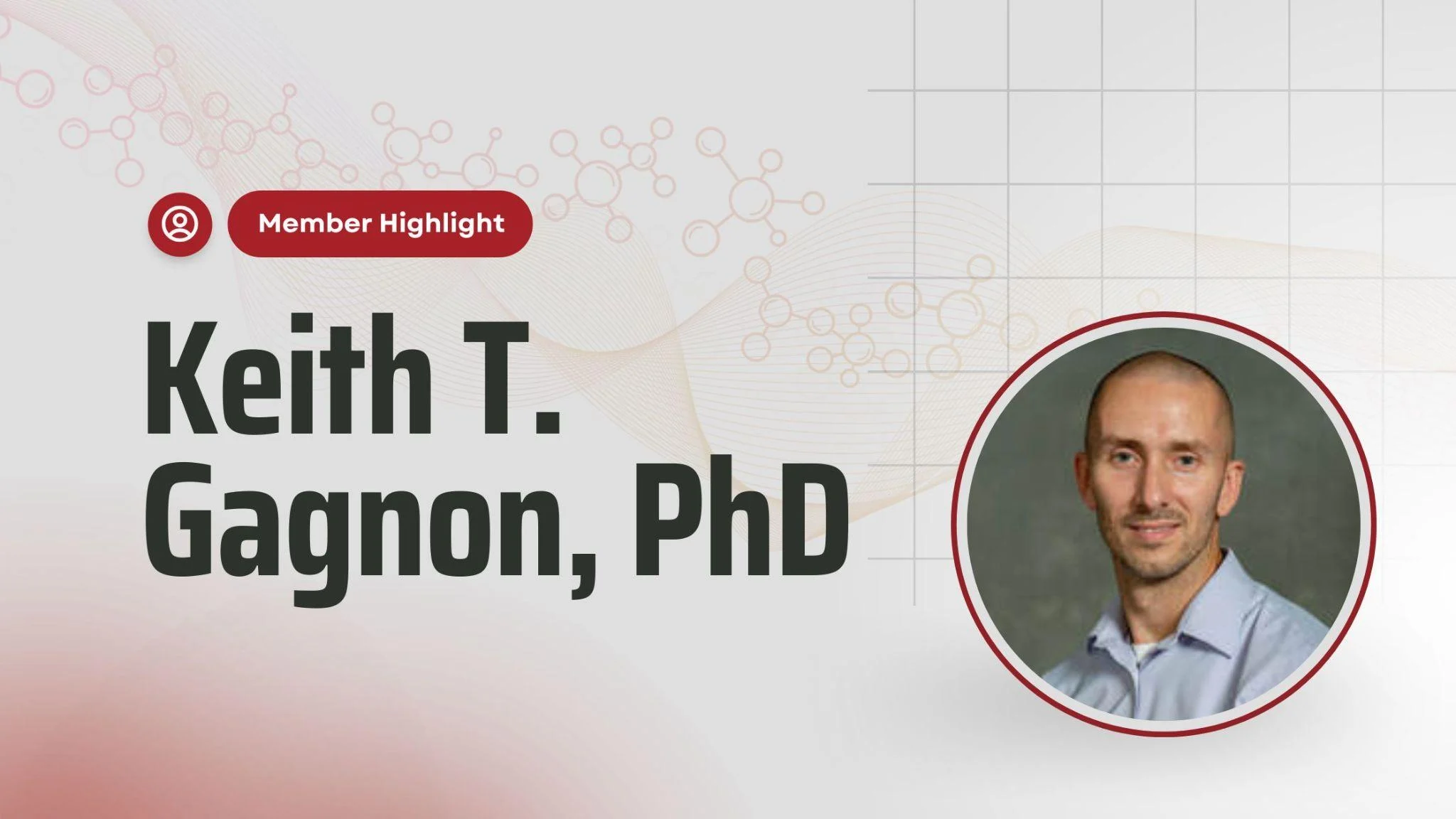
As a child, before Keith Gagnon knew anything about science, he told his mom he wanted to be a scientist when he grew up. Now, decades later, Dr. Keith Gagnon is a biochemist and molecular biologist specializing in RNA biology, nucleic acid therapeutics, repeat expansion disorders, and CRISPR-Cas systems, serving as an Associate Professor in the Department of Biochemistry at Wake Forest University School of Medicine in Winston-Salem, North Carolina.
From Construction Sites to the Laboratory
As a child, Keith was always intrigued by how things work and would often disassemble electronics. His family moved often, and Keith describes his teenage years as a bit wild and unpredictable. Growing up, he was competitive, and academics were valued in his home. In addition to loving science, he was a standout artist and was involved in athletics, including cross-country running and basketball.
“But what absolutely fascinated me was biology and chemistry,” he says. “I remember reading Campbell’s Biology, 3rd edition, and it just stuck in my head. I was able to memorize it without trying.”
Keith’s parents were a homemaker and a carpenter, and neither had pursued a secondary education. During his high school years, Keith worked in restaurants, and he credits his AP Biology teacher, Ms. Woody, for helping him realize he was good enough to attend college. After graduating, he went on to work in construction, painting, building decks, and plumbing — things he had done every summer with his dad since he was old enough. He also nearly joined the army.
“But I realized these were not what I wanted,” he says. “I wanted to be a thinker. I wanted to solve problems that would have a lasting impact. I wanted to do something big in my life. It brought me back to biology and chemistry, as well as a deeper, somewhat spiritual searching for what really mattered. I think this has driven me. ”
Discovering a Passion for Research
After being accepted to North Carolina State University and deciding a degree in art was not one that would pay the bills, Keith chose to major in Biochemistry. Warmly welcomed into the laboratory of his undergraduate advisor, Dr. E. Stuart Maxwell — a firm and direct man with a wry sense of humor — Keith’s love of laboratory science blossomed.
He continued studying under Dr. Maxwell’s supervision through graduate school and his PhD, focusing on the assembly, structure, and function of archaeal Box C/D small nucleolar ribonucleoproteins (sRNPs) (1).
“He held high expectations for data quality and creative problem solving,” Keith says. “It instilled in me a pure joy for science.”
Finding a Home in Oligonucleotide Therapeutics
Trained in “old school” protein and nucleic acid biochemistry, Keith’s doctoral research focused on RNA biology and RNA-protein interactions, particularly small nucleolar RNAs and their associated protein complexes. After completing his PhD, however, he wanted to apply those fundamental insights to more disease-relevant problems.
That desire led him to the laboratory of Dr. David R. Corey at UT Southwestern Medical Center in Dallas, Texas, where he trained as an NIH Ruth L. Kirschstein Fellow.
“I remember seeing one of his graduate students present at the RNA Society Meeting,” Keith says. “All I knew was they were doing cool RNA-guided biology in the human cell nucleus, and I needed to be there.”
Under Dr. Corey’s mentorship, Keith immersed himself in the rapidly evolving world of nucleic acid therapeutics, exploring nuclear RNA interference (RNAi), antisense oligonucleotides (ASOs), siRNAs, and strategies for targeting repeat-expansion disorders such as Huntington’s disease (2), spinocerebellar ataxia 3, and C9ORF72-associated ALS/FTD.
Keith describes Dr. Corey as patient and generous, giving him room to make mistakes while emphasizing efficiency, timeliness, and always advocating for and encouraging him. The experience shaped the direction of Keith’s career. Among his most recognized contributions is work demonstrating that RNAi mechanisms operate within the cell nucleus (3), as well as his work on the chemical modification of CRISPR RNAs, particularly his obsession with figuring out how to fully chemically modify them.
Building an Independent Research Program
In 2014, Keith launched his own academic research laboratory at Southern Illinois University School of Medicine, holding joint appointments in Biochemistry & Molecular Biology and Chemistry & Biochemistry. In 2023, the Gagnon laboratory officially moved to the Department of Biochemistry in the Wake Forest University School of Medicine.
Although the Gagnon Lab does not exclusively focus on oligonucleotide therapeutics, it employs a multidisciplinary approach that combines biochemistry, biophysics, structural biology, sequencing, cell culture, and nucleic acid chemistry. Over the years, the laboratory has made important contributions to chemically modified CRISPR guide RNAs, anti-CRISPR inhibitors, and high-throughput viral genome sequencing.
Persistence, Creativity, and Doing More with Less
Keith doesn’t hold back when discussing the challenges of scientific research.
“Nine out of ten experiments do not work out the way we anticipate,” he says. “But this is normal. You must be persistent and really creative, especially when you do not have the tools or resources you need.”
Not being flush with resources during graduate school or later when establishing his first independent laboratory forced Keith to become an exceptionally creative scientist.
“You have to be really clever to solve important problems when facing these limitations. And you have to be really careful that it does not limit how big you can think or make you give up easily.”
The Discoveries Shaping the Future of Oligonucleotide Therapeutics
Keith views the successful development of siRNA therapeutics as one of the field’s most important achievements.
“Figuring out how to make siRNAs into potent therapeutics, which involves both chemistry, safety, and delivery, especially GalNAc, was a major milestone,” he says.
He also points to the rapid discovery of biological processes that can be harnessed therapeutically, including splice-switching oligonucleotides, A-to-I editing, and CRISPR-Cas technologies. In particular, he believes prime editing and its newest generations hold enormous potential.
Applications of AI/ML tools, the discovery of new RNA biology that can be leveraged for therapeutics, and the mechanistic level of detail we are converging on for diseases are three things that Keith is excited about. “They will enable us to move more quickly and create better medicines at much lower costs,” he says.
One area Keith believes deserves renewed attention is aptamer technology. Watching a talk on the topic by Bruce Sullenger when he was a first-year graduate student cemented in Keith’s mind the potential of this approach, which uses synthetic antibodies known as aptamers, to bind with high affinity to a specific target.
“Maybe it was ahead of its time,” he says. “For basic science, it works. But broad clinical translation has been out of reach.”
Still, advances in chemistry, target discovery, and selection methods leave him optimistic that aptamers may eventually find their place in medicine.
Keith is equally enthusiastic about the role of artificial intelligence and machine learning in drug development. “We need to accept this reality while also learning to use it very responsibly,” he says.
Rather than replacing scientists, he believes these tools will increase demand for researchers capable of asking good questions, interpreting data, and thinking critically. However, he notes that a potential challenge is the accessibility and democratization of these tools for researchers, and that if they become largely privatized, this would affect the field’s long-term creative and practical progress.
What Still Stands in the Way
While agreeing that delivery remains one of the most cited barriers to broader adoption of oligonucleotide therapeutics, Keith believes another challenge receives less attention: careful experimental design.
“Trying to move too fast or making too many assumptions about underlying mechanisms we do not fully understand can not only slow down clinical translation, but it can even sour an entire field, hurting reputation and investment.”
As therapeutic platforms become increasingly sophisticated, he believes scientific rigor will become even more important. The sheer amount of data generated, and the intense race to be first to discover, first to patent, and first to market will make it even more challenging.
“Thinking mechanistically and getting it right before we go on to the next step is the classic scientific approach, and it is just as true and necessary today as it was 50 years ago.”
The Breakthroughs He’s Most Proud Of
While Keith expresses pride in all the papers he and his team have published, he’s particularly proud of two papers currently in revision. Both collaborations involved Masad Damha and esteemed colleagues, including P.I. Pradeepkumar and Sergey Korolev. The first, authored by Pater et al., originally aimed to explore the chemical modification of Cas9 CRISPR RNAs over a decade ago. However, the team encountered a significant obstacle, which Keith and Masad dubbed the “2’-hydroxyl barrier,” in which certain positions of the guide RNA’s ribose simply cannot be modified (4).
“We finally cracked the code, at least for some of these positions,” he says. “It would have been easy to give up, since this discovery required deep mechanistic investigations into Cas9 structure-function. But I’m happy we kept going, and I hope it leads to new delivery modalities for CRISPR.”
The second project focused on CRISPR guide RNA architecture, specifically comparing the effect of dual-guide versus single-guide RNAs on Cas9 activity and specificity. This endeavor proved more complex than anticipated, requiring several years of work to elucidate the mechanism. Ultimately, both projects resulted in breakthroughs.
“Stories like that, where we did not give up, are the ones I’m most proud of,” he says.
In addition to his publications, Gagnon has received numerous honors, including the OTS Young Investigator Award (2017). He has served on the OTS Board of Directors and continues to contribute through its Scientific Advisory Board.
The Mentors, Trainees, and Collaborators Who Shaped His Career
Dr. Maxwell and Dr. Corey were key mentors in Keith’s education and career. In his first independent faculty position, Ramesh Gupta, PhD, whom he describes as a wonderful department chair, also served as a mentor, sharing tips and tricks for focusing his research and navigating administrative duties, while being a true friend.
“I would say having people that inspire you, believe in you, and give you a chance can make all the difference,” he says.
Today, Keith strives to provide the same support to his trainees.
“I take their training and success very seriously. It starts with principles of how to approach problems, how to design experiments, and how to work with and treat others fairly. Things that will help them no matter where they go in life.”
Among his closest collaborators is Masad Damha, whom Keith affectionately describes as a “partner in crime.” He notes that Damha has indirectly mentored him through their shared love for exciting nucleic acid chemistry and biochemistry. Other influential collaborators include P.I. Pradeepkumar, an expert nucleic acid chemist doing great MD simulation work, Sergey Korolev, for all his help with structural studies, and Joao Mamede, who has helped Keith’s lab break into a new area of viral RNA epitranscriptomics.
“Having peers like this is wonderful,” he says. “They have shown me great patience and camaraderie.”
For young scientists considering careers in the field, his advice is simple: “Don’t give up easily. Find out what it is that you can be great at and go for it. Don’t be enamored by self-promotion, big paychecks, or fame. First, focus on training yourself to do world-class science and be a critical problem solver. Everything else will follow.”
Life Beyond the Lab
Despite his passion for science, Keith reminds himself there is more to life than science. “Kids grow up whether you are paying attention or not. And T-I-M-E is how they spell the word love. Spend the time, laugh, and forget about the cares of the world sometimes.”
Learning to accomplish more in less time, accepting that tomorrow is another day, and relying on a supportive spouse when deadlines become unavoidable have all helped him maintain balance. Remembering that saying yes to one thing means you will probably have to say no to something else, trying not to make promises that can’t be kept, and communicating clearly when obligations can’t be met are also key.
He also believes in protecting core principles. “It is important to find and hold values and principles greater than yourself that can guide your vision. Despite the pressures, you can never compromise on your core principles, in family, life, and science.” For Keith, those principles became clearer when he found Jesus during college, a decision he says unfailingly continues to guide him today.
Outside the laboratory, he enjoys volunteering in the community, spending time supporting his children’s sports and school activities, and working with his hands, which at this stage of life includes home improvement projects and fixing cars.
Legacy and Looking Ahead
Asked how he would like to be remembered, Keith’s answer reflects both his scientific ambitions and his personal values.
Professionally, he hopes to be remembered for a breakthrough that originated in his laboratory, which may be yet to come. Personally, he hopes colleagues and trainees remember him as someone who valued research creativity and quality and was generous in sharing his experiences and resources with other scientists.
“In simplistic terms, if I could help cure a disease, discover a new pathway or mechanism, and see my trainees go on to be successful, I would be quite happy.”
To stay up to date with Keith’s latest research and contributions, visit www.labgagnon.com or search BioRxiv and PubMed for new releases from his research group. To read key journal articles on his work, find a list of some of Keith’s various publications below.
Research Contributions:
- Bleichert F, Gagnon KT, Brown BA 2nd, Maxwell ES, Leschziner AE, Unger VM, Baserga SJ. A dimeric structure for archaeal box C/D small ribonucleoproteins. Science. 2009 Sep 11;325(5946):1384-7. doi: 10.1126/science. 1176099. PMID: 19745151; PMCID: PMC2975540.
- Gagnon KT, Pendergraff HM, Deleavey GF, Swayze EE, Potier P, Randolph J, Roesch EB, Chattopadhyaya J, Damha MJ, Bennett CF, Montaillier C, Lemaitre M, Corey DR. Allele-selective inhibition of mutant huntingtin expression with antisense oligonucleotides targeting the expanded CAG repeat. Biochemistry. 2010 Nov 30;49(47):10166-78. doi: 10.1021/bi101208k. Epub 2010 Nov 8. PMID: 21028906; PMCID: PMC2991413.
- Gagnon KT, Li L, Chu Y, Janowski BA, Corey DR. RNAi factors are present and active in human cell nuclei. Cell Rep. 2014 Jan 16;6(1):211-21. doi: 10.1016/j.celrep.2013.12.013. Epub 2014 Jan 2. PMID: 24388755; PMCID: PMC3916906.
- Pater AA, Barber HM, Sudhakar S, Chilamkurthy R, Jana SK, Parasrampuria MA, Bosmeny MS, Graczyk-Marrs JA, Eddington SB, Blazier CA, Abdullahu L, Malek-Adamian E, Barkau CL, O’Reilly D, Korolev S, Pradeepkumar PI, Damha MJ, Gagnon KT. Chemical control of 2′-hydroxyl-dependent Cas9 target engagement enables CRISPR RNA ribose replacement. bioRxiv [Preprint]. 2026 Jan 26:2026.01.26.701763. doi: 10.64898/2026.01.26.701763. PMID: 41659633; PMCID: PMC12874002.
- Barkau CL, O’Reilly D, Rohilla KJ, Damha MJ, Gagnon KT. Rationally Designed Anti-CRISPR Nucleic Acid Inhibitors of CRISPR-Cas9. Nucleic Acid Ther. 2019 Jun;29(3):136-147. doi: 10.1089/nat.2018.0758. Epub 2019 Apr 16. PMID: 30990769; PMCID: PMC6555185.
- Ageely EA, Chilamkurthy R, Jana S, Abdullahu L, O’Reilly D, Jensik PJ, Damha MJ, Gagnon KT. Gene editing with CRISPR-Cas12a guides possessing ribose-modified pseudoknot handles. Nat Commun. 2021 Nov 15;12(1):6591. doi: 10.1038/s41467-021-26989-z. PMID: 34782635; PMCID: PMC8593028.
- Bosmeny MS, Pater AA, Zhang L, Larkai LL, Sha BE, Lyu Z, Damha MJ, Mamede JI, Gagnon KT. A nanopore-based HIV-1 reference epitranscriptome. Nucleic Acids Res. 2026 Mar 19;54(6):gkag220. doi: 10.1093/nar/gkag220. PMID: 41854072; PMCID: PMC13000461.