



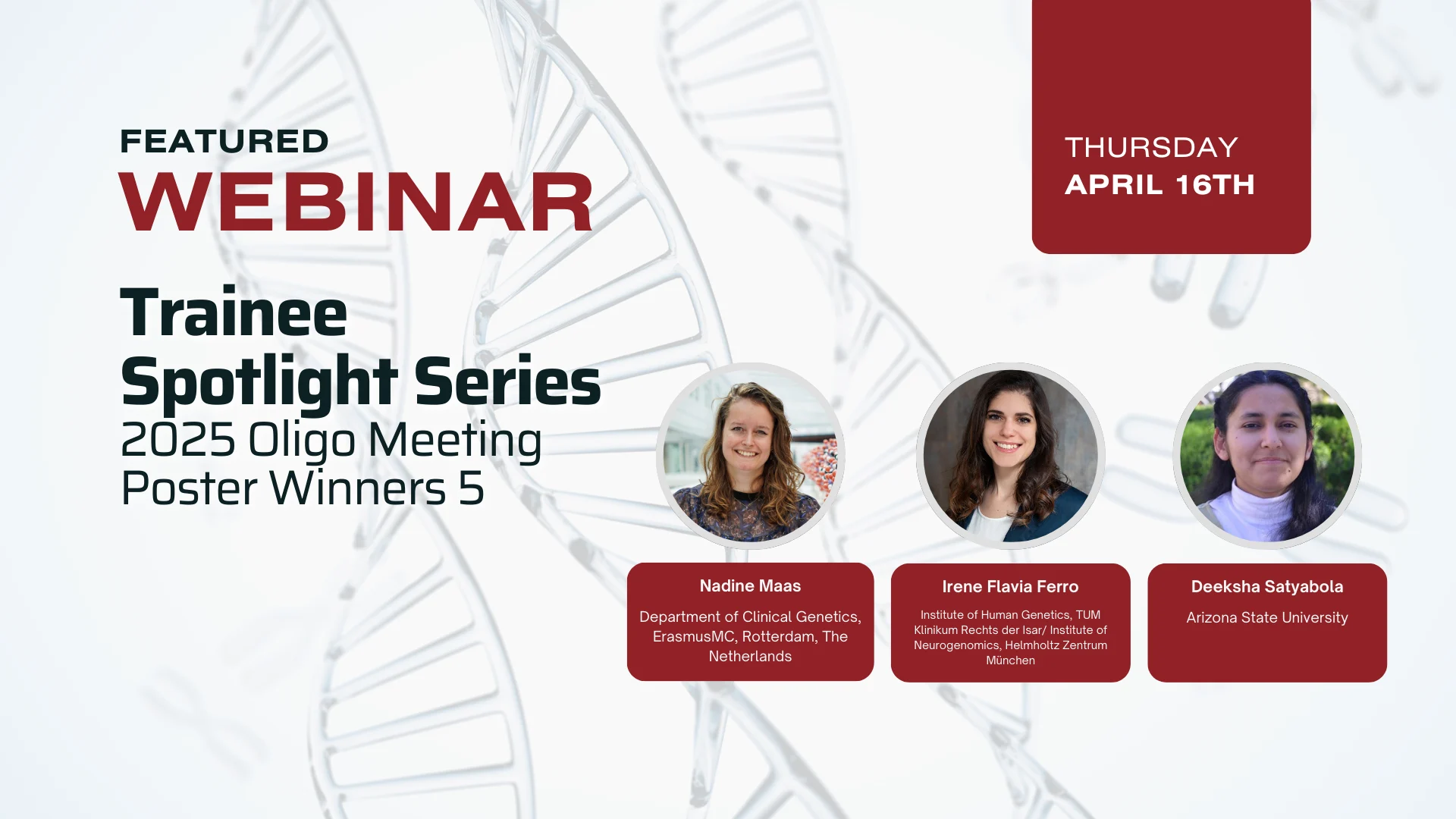
Date: April 16, 2026
Time: 11-12pm EDT / 5-6pm CEST
Title: Development of an N=1 Therapeutic Antisense Oligonucleotide for a unique UNC13A variant
Description:
Rare disorders collectively affect 3 to 10% of the population, but treatment options are scarce. Recently, genetic variants in UNC13A were identified as the underlying cause of a novel rare neurodevelopmental disorder characterized by developmental delay and seizures. Those findings include a unique heterozygous variant likely causing a gain-of-function, which could be amenable for an allele-selective ASO. After designing ASOs in silico, they are tested for their potency and selectivity in a luciferase-based screening assay and in the end, functional restoration will be tested with induced pluripotent stem cell-models. Our aim is to pave a path towards personalized treatment and ultimately to treat this N-of-1 case.
Speaker:

Title: Gapmer ASO Treatment for GRIN1-Associated Developmental and Epileptic Encephalopathy
Description:
This webinar will present recent work on gapmer antisense oligonucleotide (ASO) approaches for GRIN1-associated developmental and epileptic encephalopathy. I will describe both allele-selective and non-selective ASO designs aimed at modulating pathogenic GRIN1 expression across different disease mechanisms. Two-electrode voltage clamp recordings in Xenopus oocytes are used to evaluate the functional consequences of ASO-mediated GRIN1 knockdown on NMDA receptor-mediated currents. Overall, these findings highlight the potential of ASO-based precision strategies for GRIN1-related disorders.
Speaker:

Title: DNA-Templated Spatially Controlled Proteolysis Targeting Chimera (DTAC) for Cyclin D1-CDK4/6 Complex Protein Degradation
Description:
Shaping proximity-based therapeutics, like PROTACs, into their active conformations can dramatically improve both selectivity and potency, yet conventional strategies to do so are often labor-intensive and synthetically complex. In this webinar, we present DNA-templated, spatially controlled PROTACs (DTACs), a new approach that harnesses programmable nucleic acid self-assembly to streamline construction and precisely position inhibitors. This platform enables highly coordinated degradation of the full cyclin D1–CDK4/6 complex and demonstrates strong anticancer activity, validated through both in-vitro and in-vivo experiments.